Tuesday, December 8, 2009

Narratives

Narration

As a mode of expository writing, the narrative approach, more than any other, offers you a chance to think and write about yourself. We all have experiences lodged in our memories, which are worthy of sharing with an audience. Sometimes they are so fused with other memories that a great deal of the time you spend in writing a narrative is in the pre-writing stage. In this stage you need first to select an incident worthy of writing about and second, to find relevance in that incident. To do this, you might ask yourself what it was about the incident that gave you new insights or awareness. Finally, you must dredge up details, which will make the incident real for your reader.

Principles

Once you have selected an incident or event, you need to keep three principles in mind:

First remember to involve the reader in the story. It is much more interesting to actually recreate an incident for the reader than to simply tell about it.

Second, find a generalization that your experience supports. This is a way to help your personal experience take on importance to your audience. This generalization doesn’t need to include all humankind; it can be about yourself, men, women, or children.

Third, you should remember that although the main component of a narrative is the story, you should carefully select details that will support, explain, and enhance the story.

Conventions

  1. The narrative is generally written in the first person (I); however, the third person (she, he, it) can also be used
  2. The narrative relies on concrete, sensory detail and description to convey the point.
  3. Because the narrative is basically a story, it should contain these story conventions: a climax, and ending, and a plot including a setting and characters. All of these help you make your point.

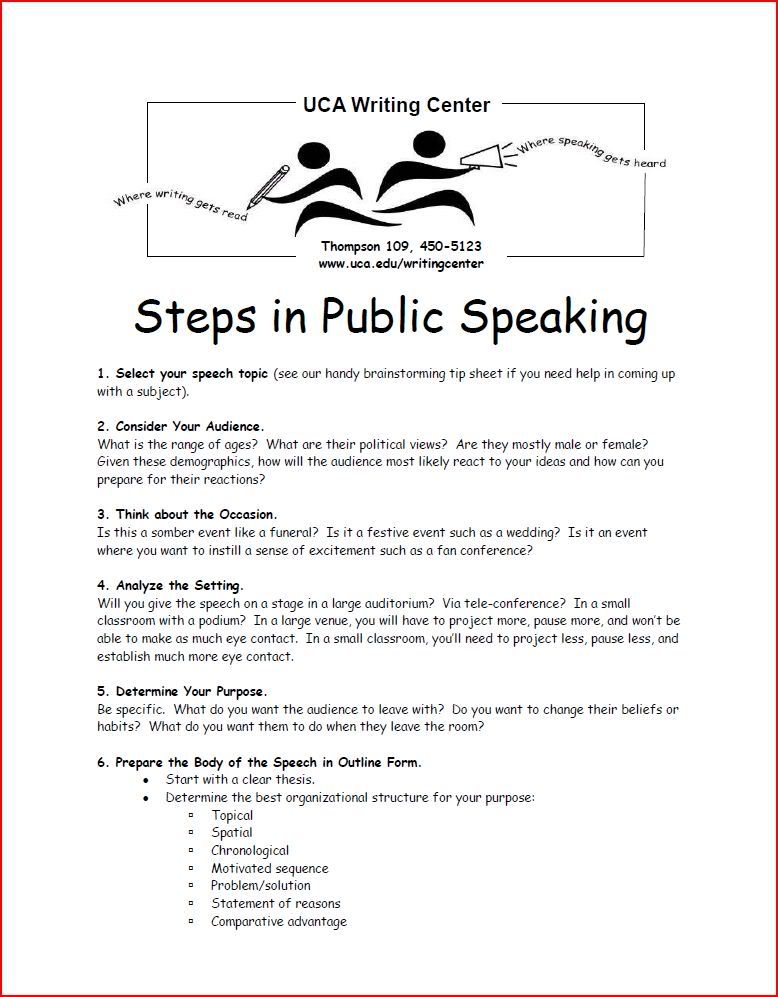
Speech Delivery

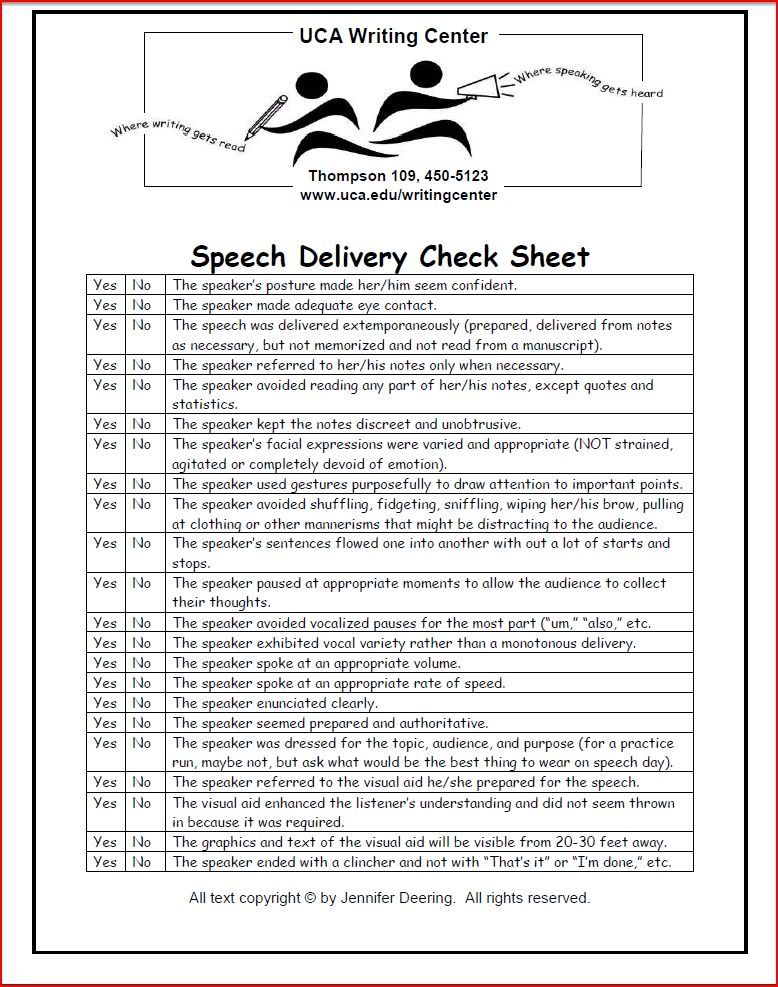
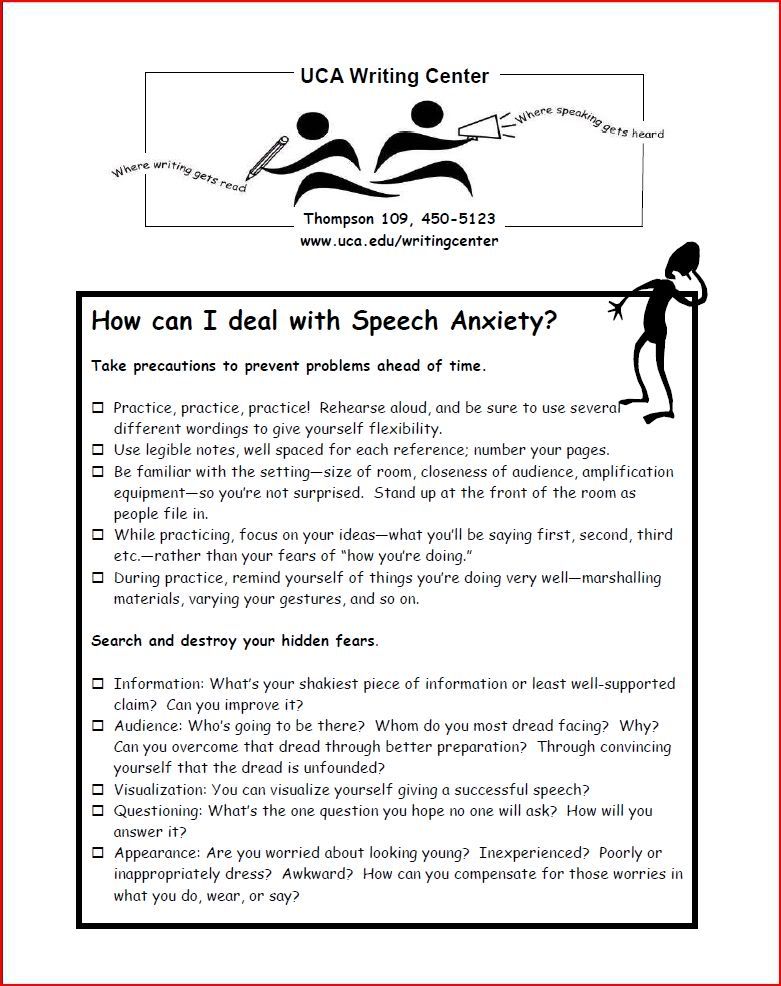
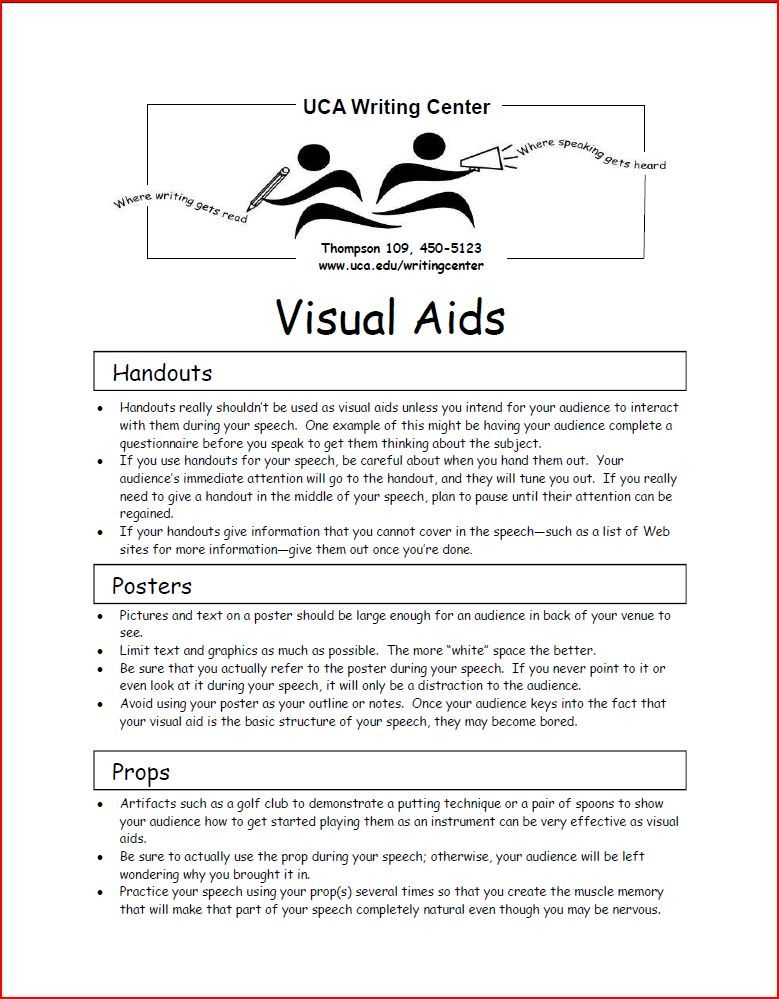
Here in the Writing Center we deal with more than just writing, we also are capable and ready to handle the problems of anyone working on a speech. We have created a series of tip sheets to not only help your speeches be more on point, clear, and concise, but to help battle stage fright, create effective visual aids, and in the areas of speech preparation. The Writing Center houses a place for anyone to come and test out their speech in front of a camera so that they can see how effective their presentation is as well as get feedback from a tutor.

Here are a few helpful guides on speech delivery ...

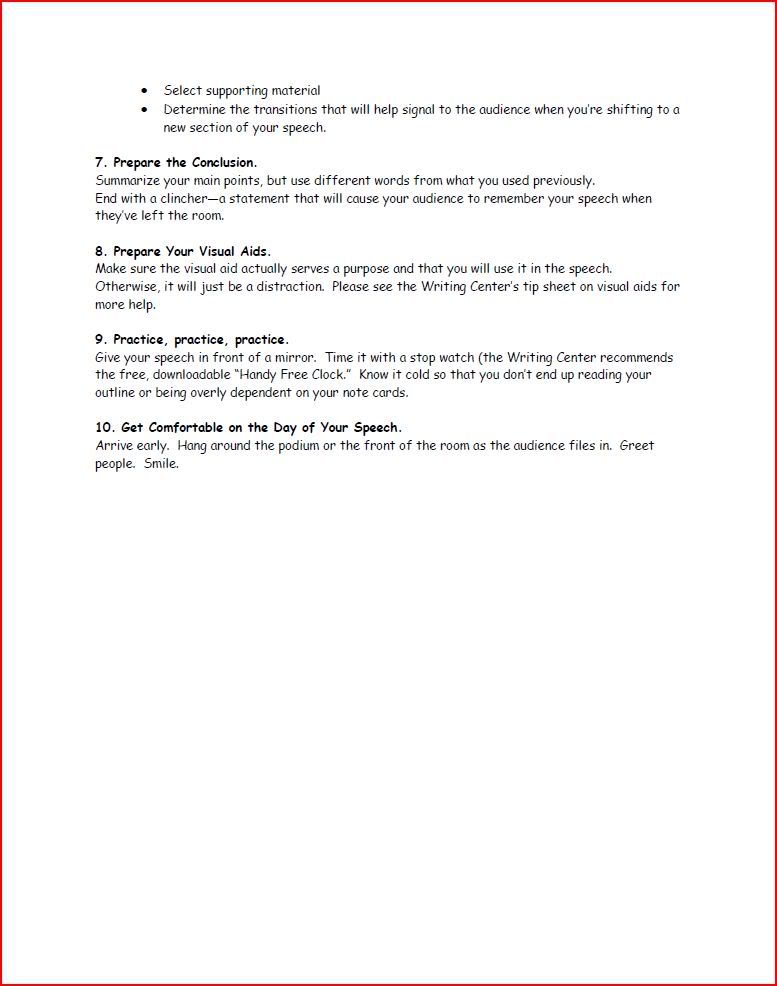
Steps in Public Speaking (Page 1 and Page 2)
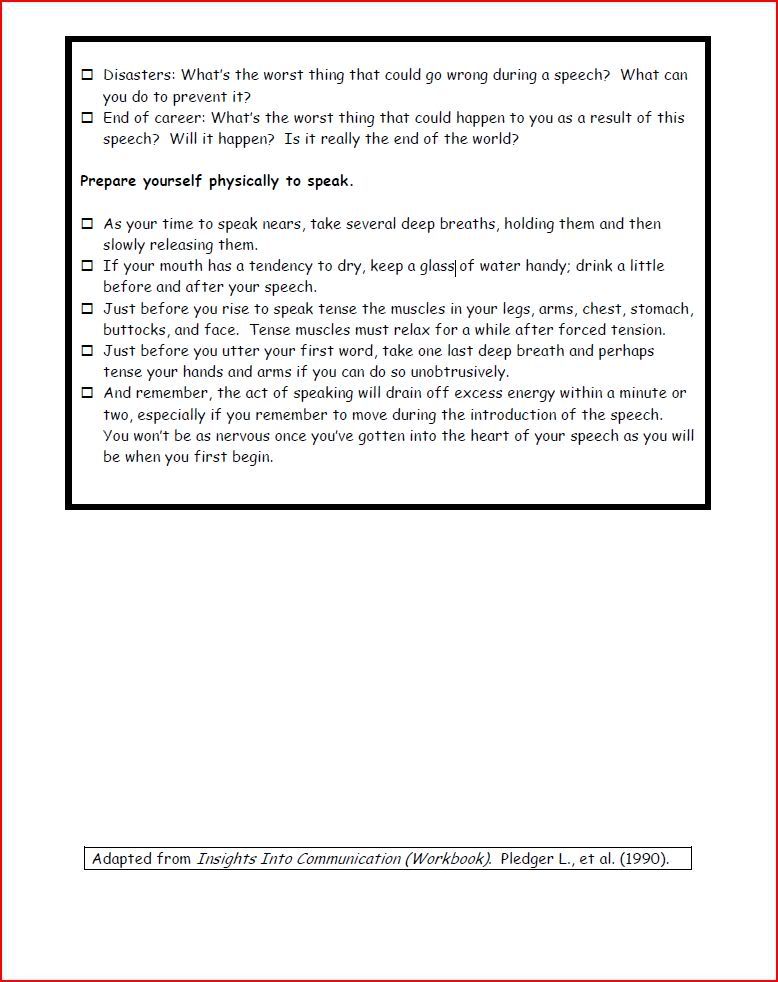
Speech Fright (Page 1 and Page 2)


The Praxis

  1. The Praxis is a teacher certification examination written and administered by the Educational Testing Service.
  2. Tot be a certified educator in the U.S. qualifying scores must be earned on all parts of the Praxis I and certain areas of the Praxis II Content Area Assessments.
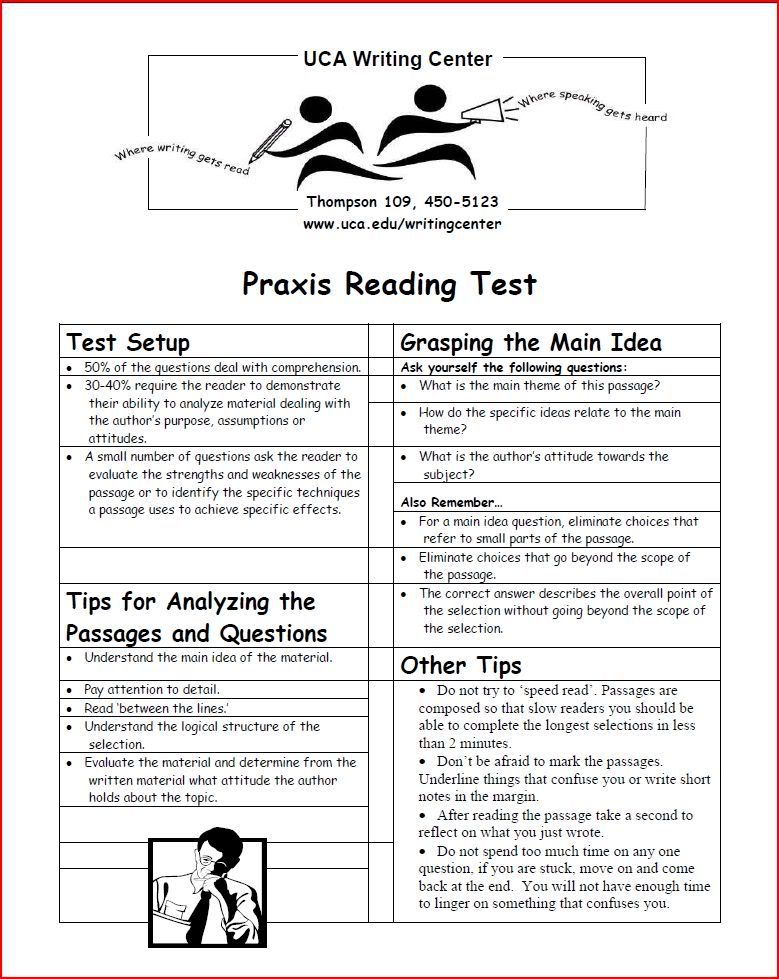
  3. The Praxis I consists of three exams: reading, writing, and mathematics.
  4. In the reading test 50% of the questions deal with comprehension, 30-40% are analyzing the material, and 10-20% are evaluating the passage.
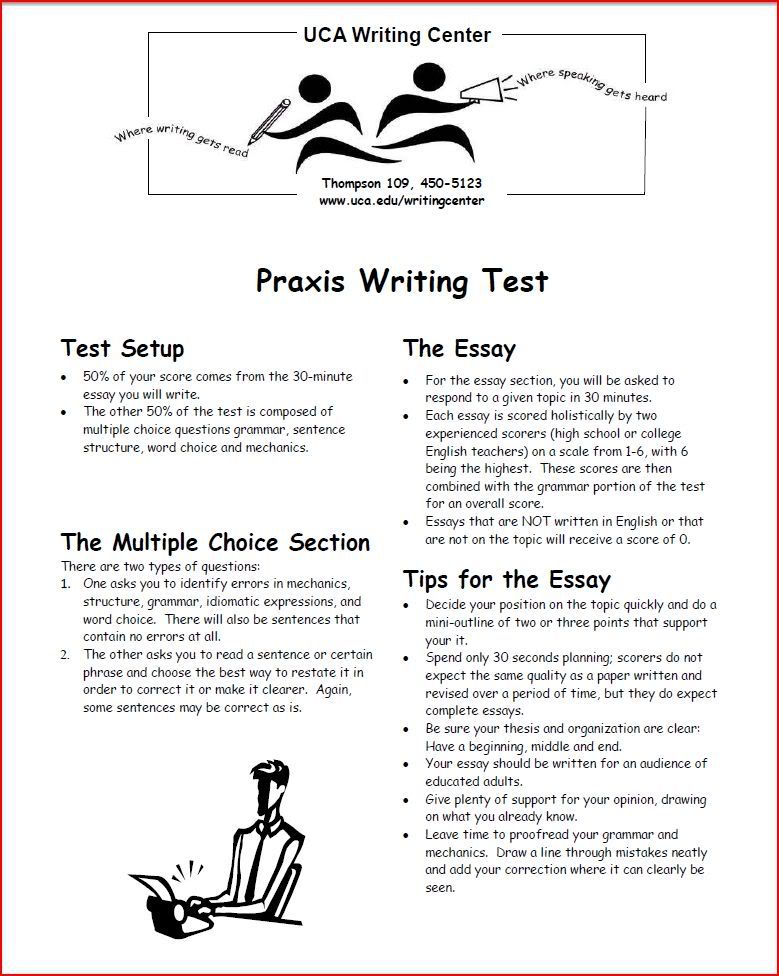
  5. In the writing test 50% of the score comes from a 30 minute writing response, and 50% is composed of answering multiple choice questions about grammar, sentence structure, word choice and mechanics.
  • Here is a link to the Writing Center's tip sheet on the reading test.
  • Here is a ling to the Writing Center's tip sheet on the writing test.

Sunday, December 6, 2009

Adapting to the Audience

When giving a speech, presentation, or in writing a paper one of the major concerns you should have is your audience. Who is your audience, you ask? Your audience is the majority of the people who will be hearing, seeing, or reading your work. Audiences can be friendly (they like what you are saying), neutral (they don't care what you are saying), or hostile (they dislike what you are saying). Each type of audience merits a different approach to how you deal with your information.

Here is a link to a tip sheet with some helpful hints for each of these three audience types provided by the Writing Center.


EDIT:: I would add that there are two more categories that an audience falls into: knowledgeable and un-knowledgeable. This factor determines the kind of language you use and the level of explanation terms merit. With a knowledgeable audience (e.g. an article in a national physics review) the language tends to be more academic and technical with a greatly reduced amount of explanation with terms. With an un-knowledgeable audience (regular papers and articles) the language uses more vernacular and general terms. If any technical terms are introduced they are explained in the course of the writing.

Introductions and Conclusions

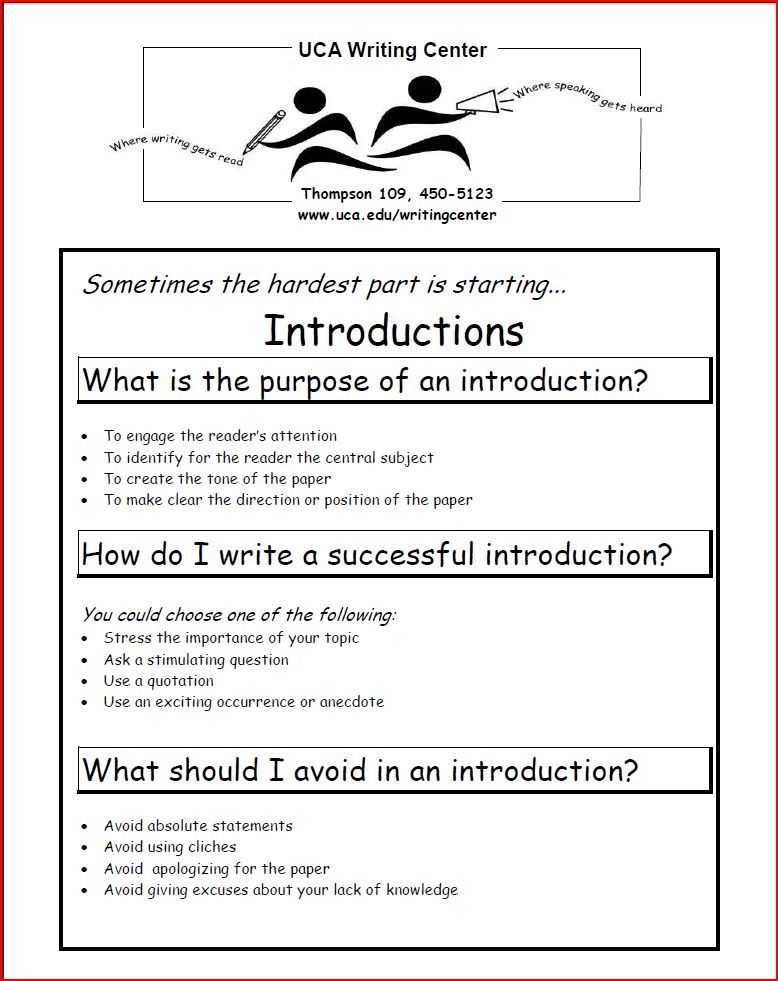
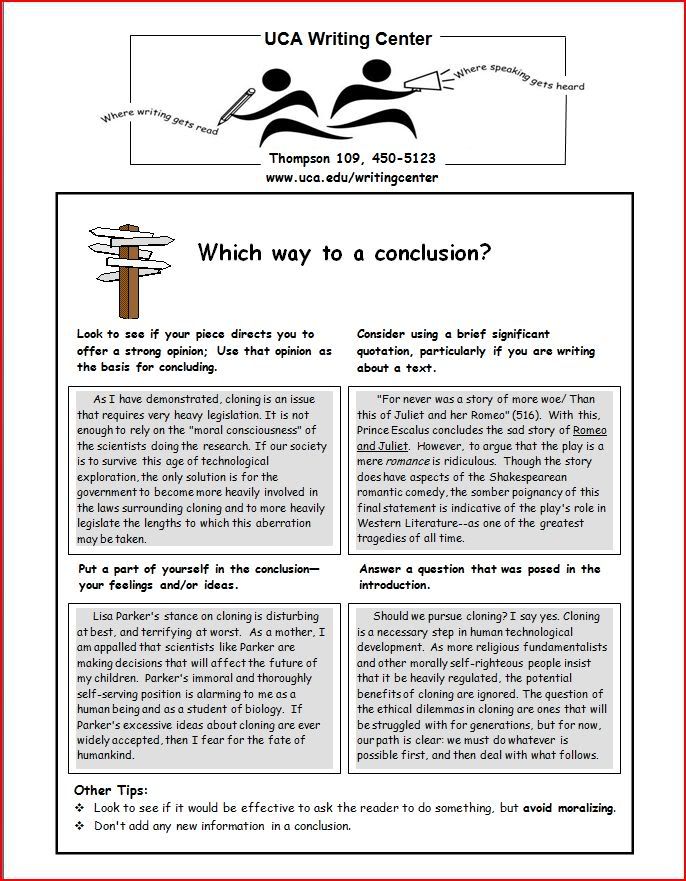
The introduction and conclusion are the bread in a paper sandwich. While they may not be the most flavorful parts of the writing, they are certainly needed to keep everything else together. An introduction grabs the readers attention and shows him or her where the paper is going. It briefly outlines some of the main points and creates a clear tone and position. While the conclusion gives the reader a brief synopsis of the paper without repeating any information or introducing any new information. It also gives the reader a sense of finality by directly answering any questions proposed in the introduction.

Here are the Writing Center's tip sheets on the introduction and the conclusion.

Online Library Resources

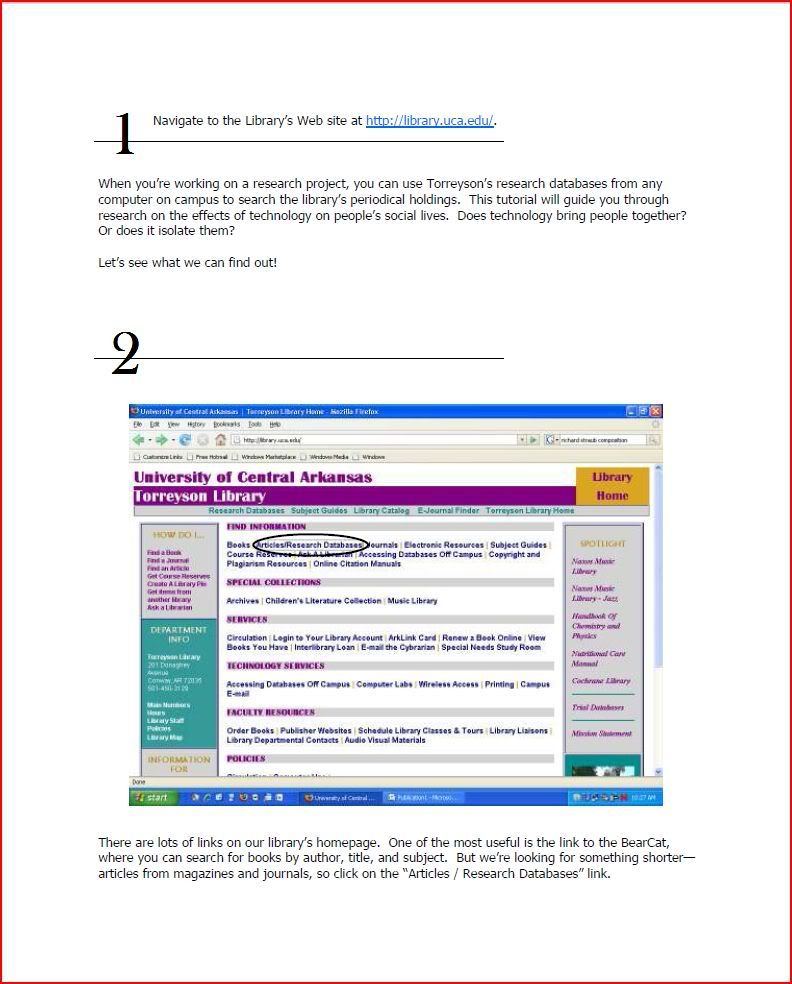
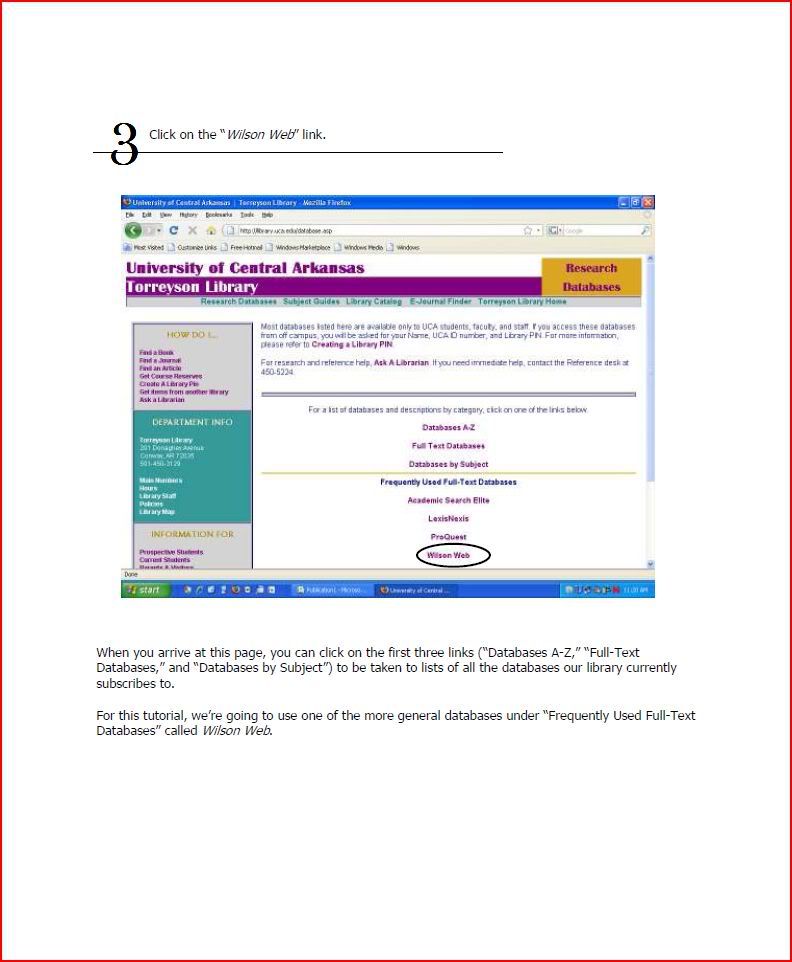
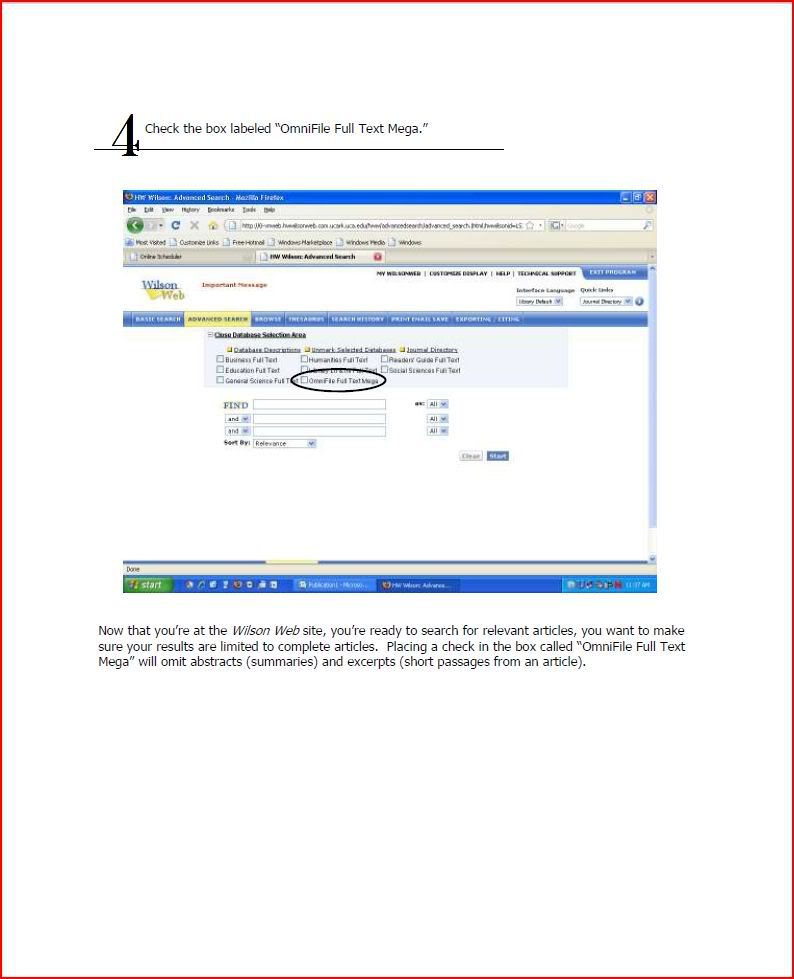
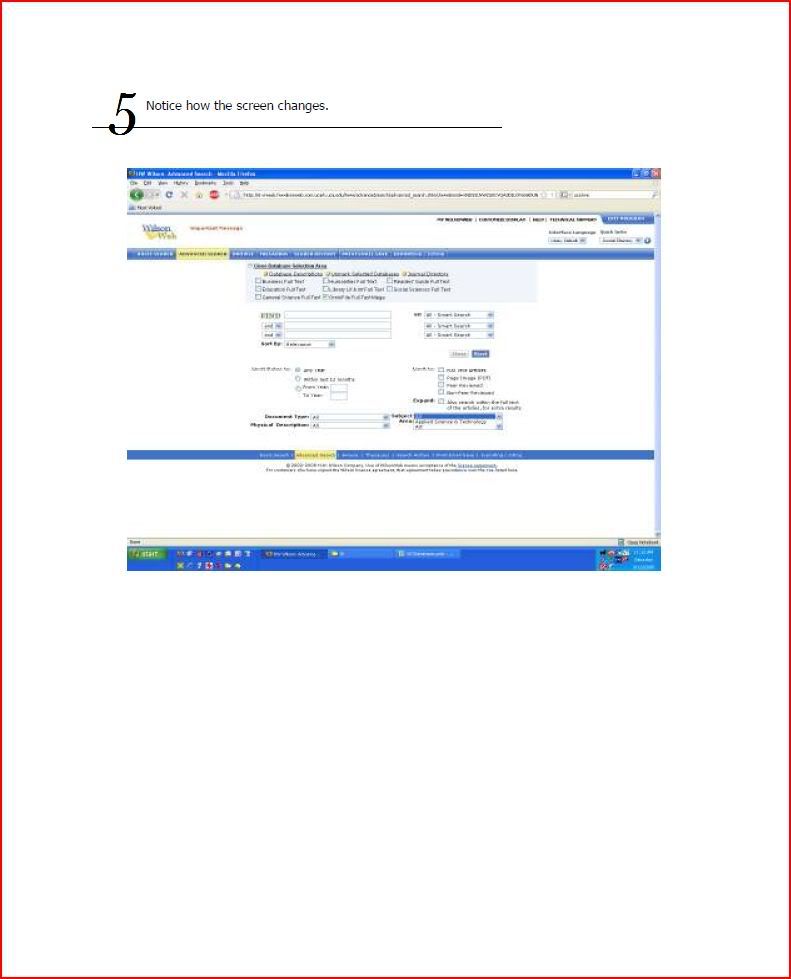
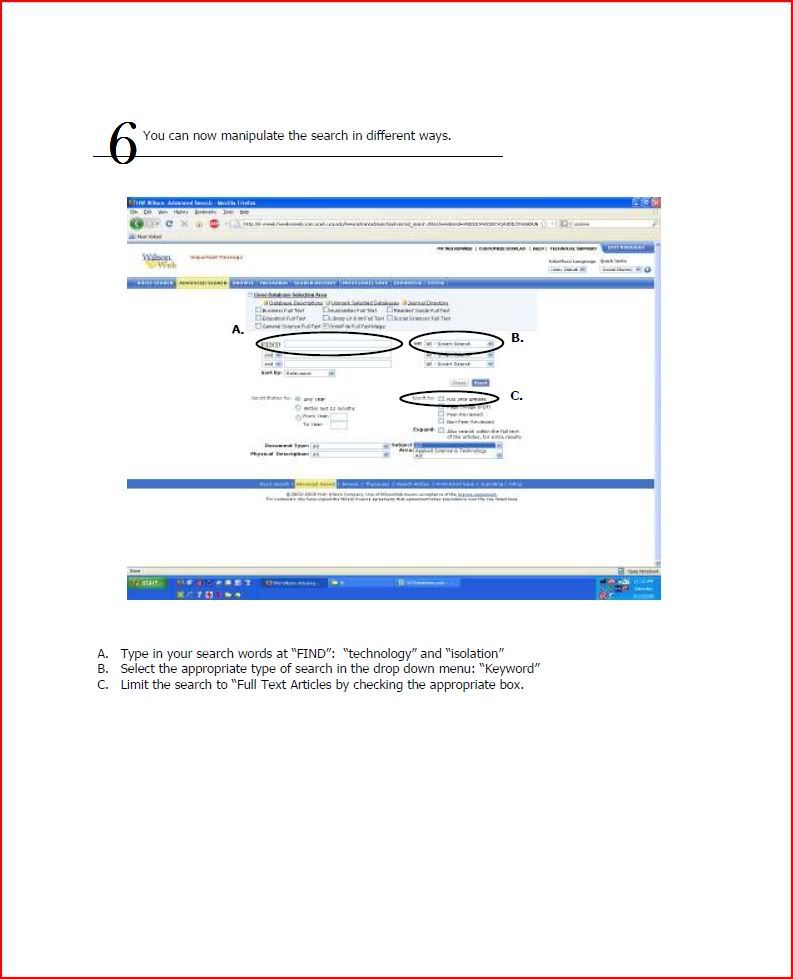
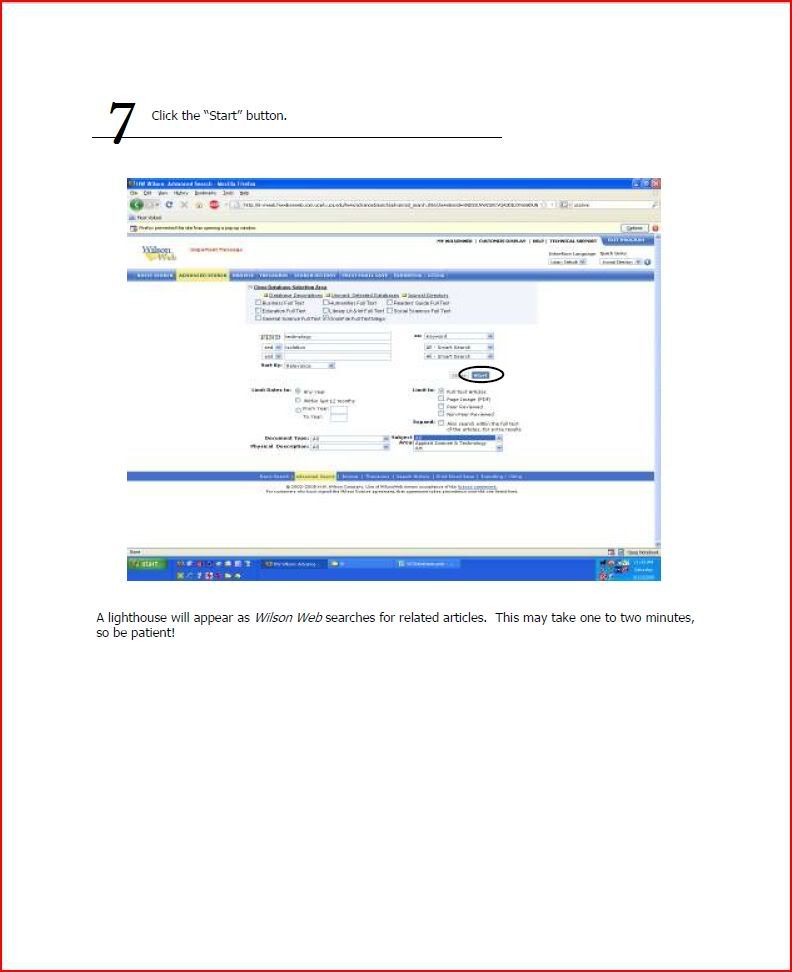
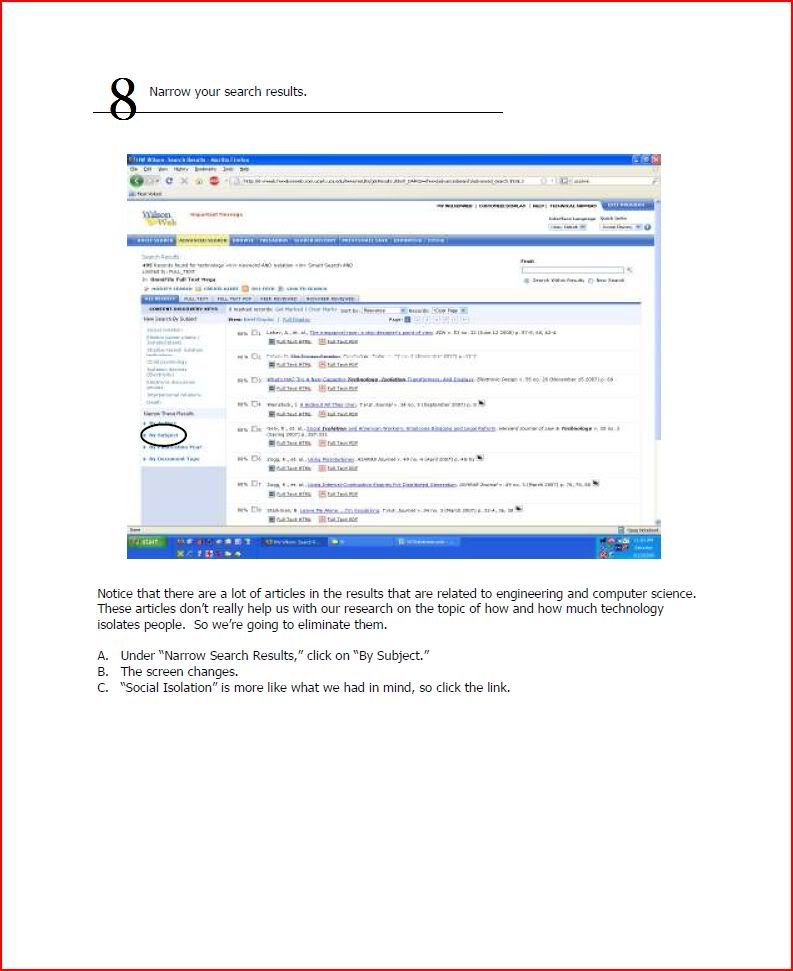
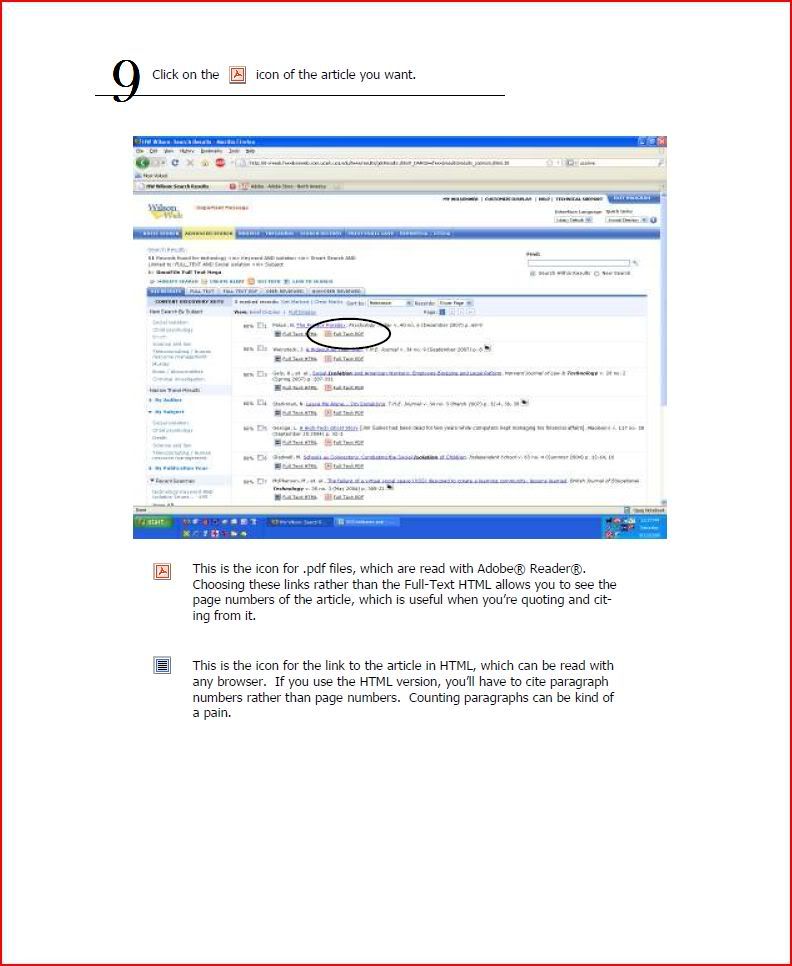
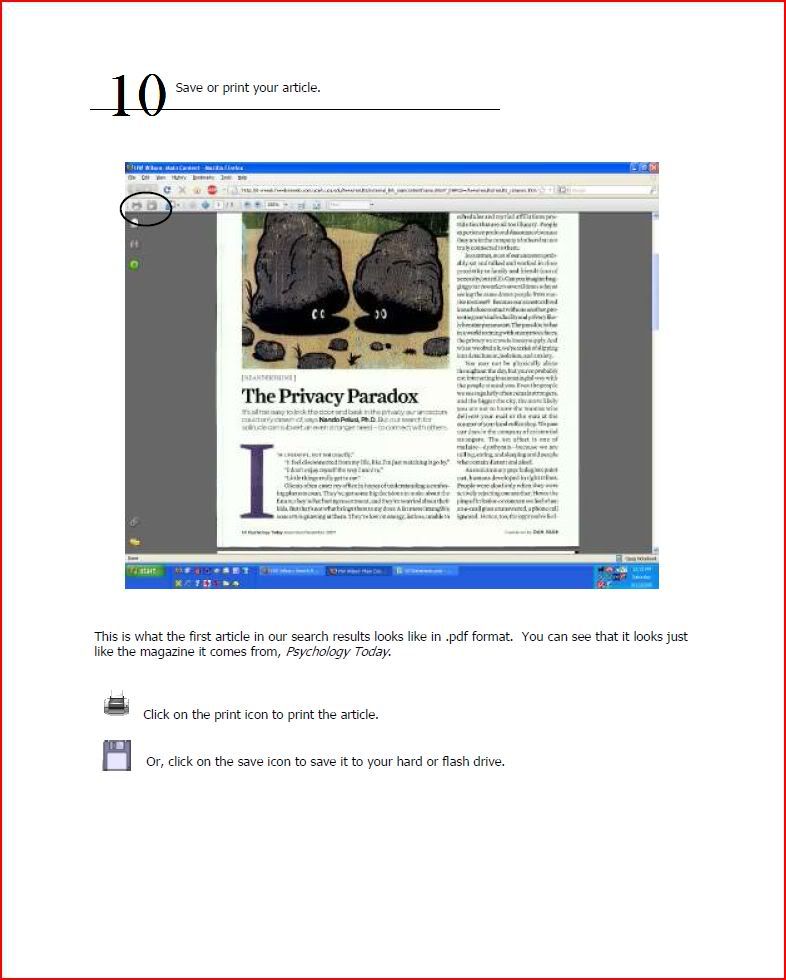
UCA's Torreyson Library has a variety of online resources beyond what already lies in print within the library. These include field-specific journals and databases that can really improver your research and add a greater depth and scope to your writing. This is not to say that you will always find what you are looking for online, and in many cases you will need to seek the physical books or journals in the library or on inter-library loan. However, here is a quick tutorial on how to use the online databases.

Setting the Hook

Ask the reader thought-provoking questions
In June of 1948, The New Yorker published “The Lottery,” a story by Shirley Jackson. Within days the magazine began to receive a flood of telephone calls and letters, more than for any other piece of fiction they had ever published. Almost all of those who wrote were outraged or bewildered—or both.
Why did this story provoke such a reaction? Why does it still shock readers?
Perhaps the answer lies in Jackson’s ability to depict so well the surface appearance of civilized society and the actual brutal, barbaric nature that lies just beneath this veneer.

Set the Scene, but don’t forget the punch!
It is a small village, a quiet one, where folks farm and square dance and buy coal to heat their houses and dutifully send their children to school. And these same folks, men who borrow tools from each other and women who exchange recipes, families who attend fund-raising pie suppers and Halloween programs, these folks get together every year and brutally murder one of their neighbors.
Who are these people? They are creations of Shirley Jackson, who created such a town and such a folk in “The Lottery.” But these people are also you and I, for Jackson makes clear in her story that the casual inhumanity exists in all our lives.

Use relevant quotations
“It isn’t fair, it isn’t right…”
These are the screams of Tessie Hutchinson and the words with which Shirley Jackson concludes her short story “The Lottery.” But it is not Tessie’s voice which remains even after the story is over; it’s Old Man Warner’s. “There’s always been a lottery,” he explains, seemingly vexed that others might question its continuance. This statement, set against the barbaric stoning of an innocent person, points us to one of the story’s compelling themes: a tradition is empty and meaningless when the reason for its observance has been forgotten.

Become a part of the paper
I didn’t understand. Why was Tessie saying something about the drawing being unfair? Didn’t she want to win the lottery? I read on, continuing to be puzzled by everyone’s relief at not drawing the winning ticket. What kind of lottery was this, anyway? By the end of the story I knew. And it made me angry, angry not only at these villagers who would do something so stupid, but angry too at Shirley Jackson, the author of “The Lottery” who had brought me to this unexpected ending. Looking back through the story, however, I realized that Jackson had worked hard from the very beginning to create the ironic twist that makes the story’s conclusion so compelling.


Homphones

The English language is often a confusing place to wander in. For instance, we come across words that sound alike but have different meanings (homophones) or words that have similar meanings but specific rules for using one word over the other.

Here’s a few for some clarification.

Lose = misplace
Loose = shaky or set free

May be = it is possible that
Maybe = possibly

Affect = to alter or influence
Effect = result of

Sit = be seated
Set = to place something.

Farther = distance
Further = additional

Whose = indicates possession
Who’s = contraction of it is.

Their = possessive form of they
There = adverb –nothing to do with people
They’re = contraction of they are

Accept = to receive
Except = to exclude

Advice = noun—an opinion
Advise = verb—to offer

Principal = main person or thing
Principle = fundamental rule or truth

Anyone = any person at all
Any one = one of a group

Everyone = every person
Every one = all of a group

Assure = to state with confidence
Ensure = to make sure
Insure = to make sure to protect against loss

Imply = suggest without actually saying so
Infer = draw a conclusion based on evidence

Elicit = to bring out
Illicit = illegal

Explicit = expressed directly
Implicit = implied

Lay = to put or place something
Lie = to rest or recline

Here is a link to some more of these tricky little words.

The Comma

Unlock the secrets of…
The Comma

The comma is probably the most used and misused mark of punctuation. Still, we can’t memorize all of the gazillion rules, so just remember…

Three Key Rules!
Use a comma and one of the FANBOYS (for, and, nor, but, or, yet, so) to connect two complete sentences.
Ex: No one seemed to take to Madeline, but her pet ferret was a big hit at the party.

Use a comma after an opening word or phrase.
Ex: Because she wasn’t getting any attention, Madeline tried to take her pet ferret home.

Use a comma to set off any information that isn’t necessary in the sentence.
Ex: The ferret, whose name was Sam, ran away from Madeline and hid under the couch.

The Comma Cop says…
A comma splice is a bad thing!

Don’t stick a comma between two complete sentences. If you do stick a comma between two complete sentences, you will be guilty of creating a comma splice.

If you want to connect two complete sentences, you can use a comma with a joining word after it (FANBOYS). The FANBOYS are the only words that will let you stick a comma between two complete sentences. Here’s an example.

WRONG: I bought a new car, I wrecked it.

CORRECT: I bought a new car, but I wrecked it.

A comma plus the joining word “but” makes the sentence correct.

Try these for practice. Which sentences contain a comma splice?
1) Margo and Jen went to dinner, they decided to go to Casa Mia for Mexican food.
2) Jen ate chips and salsa, so she wasn’t hungry when her entrée was served.
3) Margo saved room for her entrée, she was looking forward to her chimichanga.
4) Margo ate jalapeno peppers, Jen didn’t eat any.
5) Margo took home heartburn, but Jen took home a doggy bag.

Saturday, December 5, 2009

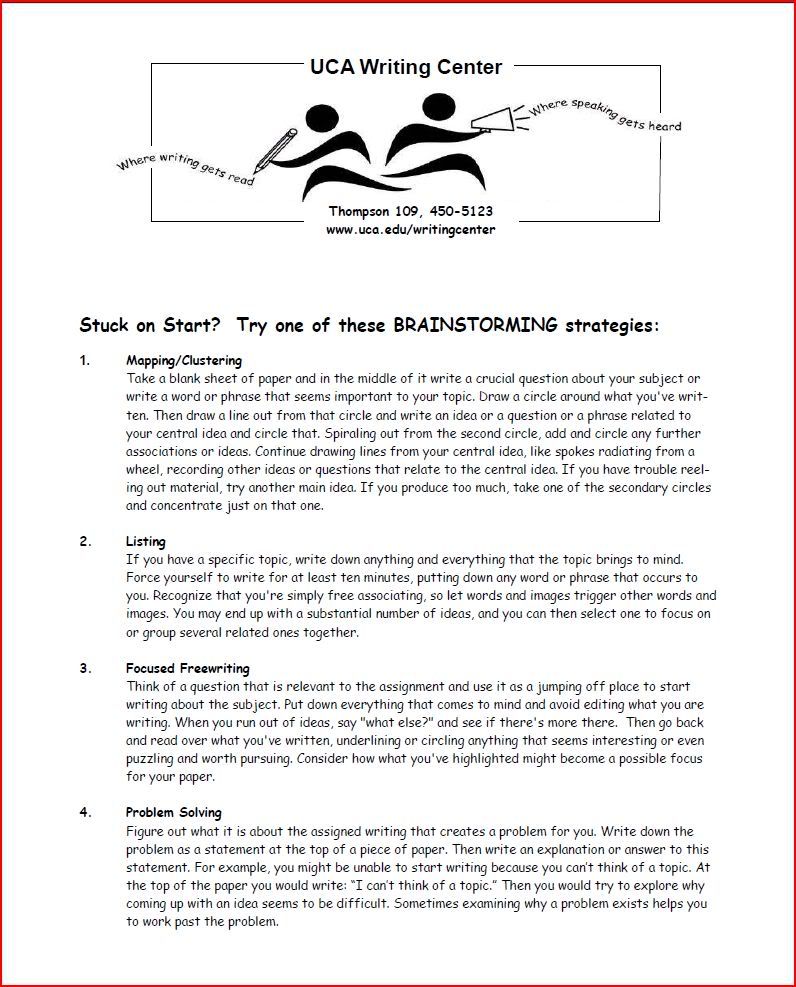
Brainstorming

1. Mapping and Clustering

  • Take a blank sheet of paper and in the middle of it write a crucial question about your subject or write a word or phrase that seems important to your topic. Draw a circle around what you've written. Then draw a line out from that circle and write an idea or a question or a phrase related to your central idea and circle that. Spiraling out from the second circle, add and circle any further associations or ideas. Continue drawing lines from your central idea, like spokes radiating from a wheel, recording other ideas or questions that relate to the central idea. If you have trouble reeling out material, try another main idea. If you produce too much, take one of the secondary circles and concentrate just on that one.

2. Listing

  • If you have a specific topic, write down anything and everything that the topic brings to mind. Force yourself to write for at least ten minutes, putting down any word or phrase that occurs to you. Recognize that you're simply free associating, so let words and images trigger other words and images. You may end up with a substantial number of ideas, and you can then select one to focus on or group several related ones together.

3. Focused Freewriting

  • Think of a question that is relevant to the assignment and use it as a jumping off place to start writing about the subject. Put down everything that comes to mind and avoid editing what you are writing. When you run out of ideas, say "what else?" and see if there's more there. Then go back and read over what you've written, underlining or circling anything that seems interesting or even puzzling and worth pursuing. Consider how what you've highlighted might become a possible focus for your paper.

Problem Solving

  • Figure out what it is about the assigned writing that creates a problem for you. Write down the problem as a statement at the top of a piece of paper. Then write an explanation or answer to this statement. For example, you might be unable to start writing because you can’t think of a topic. At the top of the paper you would write: “I can’t think of a topic.” Then you would try to explore why coming up with an idea seems to be difficult. Sometimes examining why a problem exists helps you to work past the problem.
Here is a link to a printable jpeg of this information provided by the Writing Center.

Active and Passive Voice

One of the key concerns in writing any sentence is to clearly convey who die what. The way you write can change how a sentence is perceived, whether the action is the focus or the character. There are two distinct voices which you can write in: active and passive voice.

Active Voice
  • The subject of the sentence performs the action of the verb.
  • The sentence makes clear who or what is doing the action.
  • Sentences in the active voice are more concise; meaning fewer words are needed.
  • The emphasize the doer of the action.
  • They are often more dramatic and direct.
Passive Voice
  • The subject of the sentence receives the action of the verb.
  • The sentence focuses the attention on the action instead of the doer of the action.
  • The sentences are more oriented on the action.
  • They may also be perceived as more objective.
Helpful hint: the passive verb will include a form of the verb to be, such as is, are, was, or is being.

Example of the passive voice:

"A change in attitude towards Mexico is occurring on the part of the United States. In the past, an intervention attitude would have prevailed, but now a more patient attitude is being substituted. Since the NAFTA agreement, Mexico is being treated like a partner by the United States rather than an inferior."

Example of the active voice:

"The United States is changing its attitude towards Mexico. In the past, the U.S. would have intervened in Mexican affairs; since the NAFTA agreement, however, the United States is treating Mexico more like a partner."

A Simple Introduction to Poetry

  1. First and foremost, poetry is about the process of creation. Do what you feel is right.
  2. These are not rules that have to be followed 100%, but they are general guidelines to follow when experimenting with poetry.
  3. Try to avoid end-rhymes. Generally speaking they weaken the impact of your poem and give it a childish feel. End-rhymes also limit your word use because when you could use a more descriptive, visually evocative word you have to also make sure that the work fits with the overall scheme. However, the correct use of an internal rhyme (or a rhyme contained within the lines of poetry) can increase a line's impact.
  4. Avoid the repetition of words or phrases in your poem unless you are specifically doing it on purpose. If you cant think of another synonym try using a metaphor to get your meaning across.
  5. In most writing, poetry included, metaphors are stronger than smilies. Why say what something is like when you can show your reader what something is? For example: My mother was like an angry hornet OR my mother is an angry hornet. Which one gives you a better mental image?
  6. There are hundreds of forms of poetry already in existence, a fun exercise is to take one of those forms and adapt it for yourself. This is not to say that you have to follow, even partially, a particular form of poetry. You can write free form whatever comes to mind.
  7. In some cases the layout of a poem is as important as what the poem is saying, visual elements on the page can emphasize or de-emphasize a word or phrase.
Here are some examples to get you started:

Semiology of Graphics

  1. In creating a flier or in a presentation, Jacques Bertin (a French theorist and cartographer) created a simple list of elements to follow to keep your audience in tune with your message.
  2. Not all of these elements have to be present for your message to be successful, but they help whoever is viewing your presentation to create a "visual hierarchy."
  3. A visual hierarchy is where your eyes go to first, second, third (and so on) when an image is first presented to you
  4. These elements are: Size, Value (i.e. darker shade gains more attention than a lighter shade), Texture (e.g. plaid, dots, etc...), Color, Orientation (e.g. vertical, angled, etc...), and Shape.
  • Here is an example of a flier that uses most of these qualities.

Chicago/Turabian Citation Style

  1. Some professors use the Chicago Manual and Turabian Style interchangeably, however they are -not- exactly the same.
  2. The Turabian Style was adapted from the Chicago Manual for papers, theses, and dissertations, while the Chicago Manuel refers more to publishers, editors, and authors of journal articles. If you are unsure which to use, please refer to your professor for specific instructions.
  3. The Chicago Manual is sometimes used in the curriculum for art history, political science, art history, geography and others depending on the professor.
  4. There are three different citation formats for the Chicago/Turabian style: bibliography with footnotes, bibliography with endnotes, and author-date format.
  5. These styles allows writers to support their own ideas with pre-existing information while ensuring that each source is correctly documented (be it a direct quote or paraphrasing) in the hopes of eliminating any possible accusation of plagiarism.
  6. The fifteenth edition of the Chicago Manual was published in 2003 and the seventh edition of the Turabian Style was published in May of 2007.
  • Here is a link (PDF) to basic Chicago/Turabian guidelines provided by the Writing Center on the endnote/footnote formats.

MLA Citation Style

  1. MLA stands for the Modern Language Association, and their methods of documentation are used primarily in the liberal arts curriculum (e.g. Literature, Speech Pathology, Linguistics, etc...).
  2. This style allows writers to support their own ideas with pre-existing information while ensuring that each source is correctly documented (be it a direct quote or paraphrasing) in the hopes of eliminating any possible accusation of plagiarism.
  3. The seventh edition of the MLA Manual and Guide to Scholarly Publishing was published in 2009.

APA Citation Style

  1. APA stands for the American Psycological Association, and their methods of documentation are used primarily in scientific papers withing the fields of hard, behavioral, and social sciences (e.g. physics, sociology, chemistry, psychology, etc...).
  2. This style allows writers to support their own ideas with pre-existing information while ensuring that each source is correctly documented (be it a direct quote or paraphrasing) in the hopes of eliminating any possible accusation of plagiarism.
  3. The sixth edition of the APA Guidebook was published in July of 2009.